
Ancient Nards
The restoration of the soul, mental clarity, and the passage between the worlds of thought
The sensible world and the intellectual world are like twins resting upon a dynamic thought. This dynamic thought, in its symbolism, is represented by a (white) horse. Among the Indo‑Europeans, the horse is linked to the vital breath and to the soul in motion. In the Vedas, the Aśvin are divine twins. Their name comes from aśva = horse. They drive a chariot pulled by celestial horses. They represent the awakening of thought, the mental clarity that rises like the light of dawn.
Our olfactory memory and the treasures of the brain and its symbolism
The horse is also linked to return, to the path, to inner navigation, to the boat. In certain Indo‑European traditions, the horse accompanies the soul on its journey, evoking memory as a form of passage.
Ancient nards and valerian
India and ancient Egypt shared their knowledge, and above all the nard, which Egyptian priests used in funerary rites to help the soul cross the passage into the other world. Nard and valerian are considered limbic plants.
The limbic brain is the ancient heart
It gathers the places where emotions are born and where memories are woven: the amygdala, guardian of inner impulses, and the hippocampus, architect of memory. The ancients perceived its profound nature. For them, this center was the seat of the divine breath, of prāṇa, of pneuma, the place where the soul breathes and remembers.
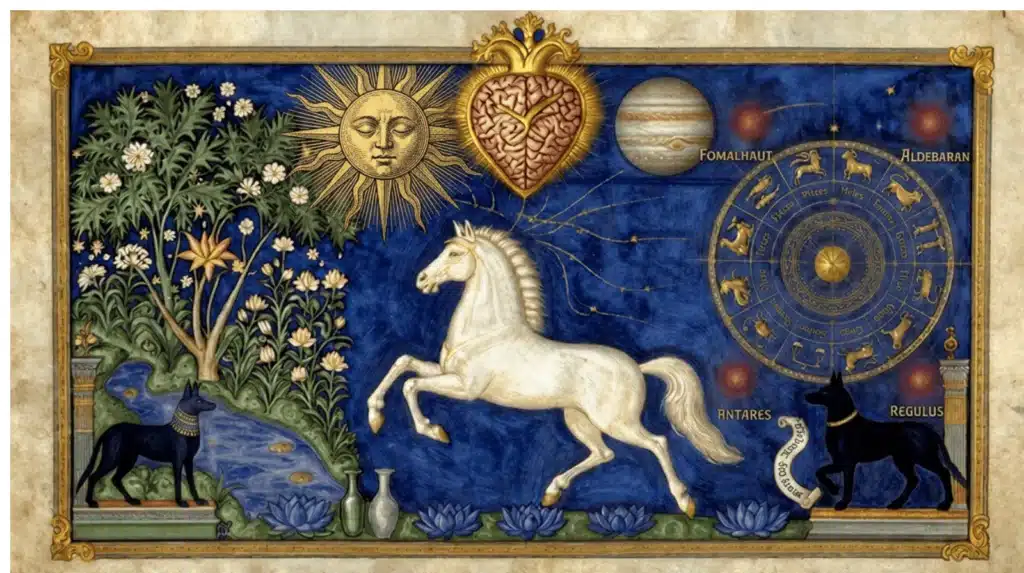
In the light of Leo, scent touches the soul faster than reason
Olfaction guides the soul in its quest. It descends directly into this inner sanctuary that is the seat of moral justice (the heart, symbol of Leo).
Nard is used to create a bridge that opens access to the sensible world by soothing emotions and opening memory. The ancients saw the limbic system as the heart‑breath‑soul corpus, making the limbic system the twin of the heart — a temple where breath, emotion, and memory meet, a place where fragrance opens the doors of the sensible world.
With mastered thoughts, the path to the garden (the sensible world) becomes accessible, like the guardians Oup and Wepwawet, placed upon the columns of reversal, keepers of knowledge and protectors of secrets and cyclical times, like two riders on the horse of thought.
Nard symbolizes the invisibility of the divine
Nard, like sacred perfumes, represents the other face of the divine: it is the breath, the scent of the gods, the invisible.
Ancient traditions believed that where there is a sacred perfume, there is a god. This invisible dimension also possessed its visual incarnation of the sacred: the color blue.
Blue, visual incarnation of the sacred
Blue does not belong to the earthly dimension. It is the expression of the visibility of divinity (see the text on alchemy). It belongs to the cosmic sphere.
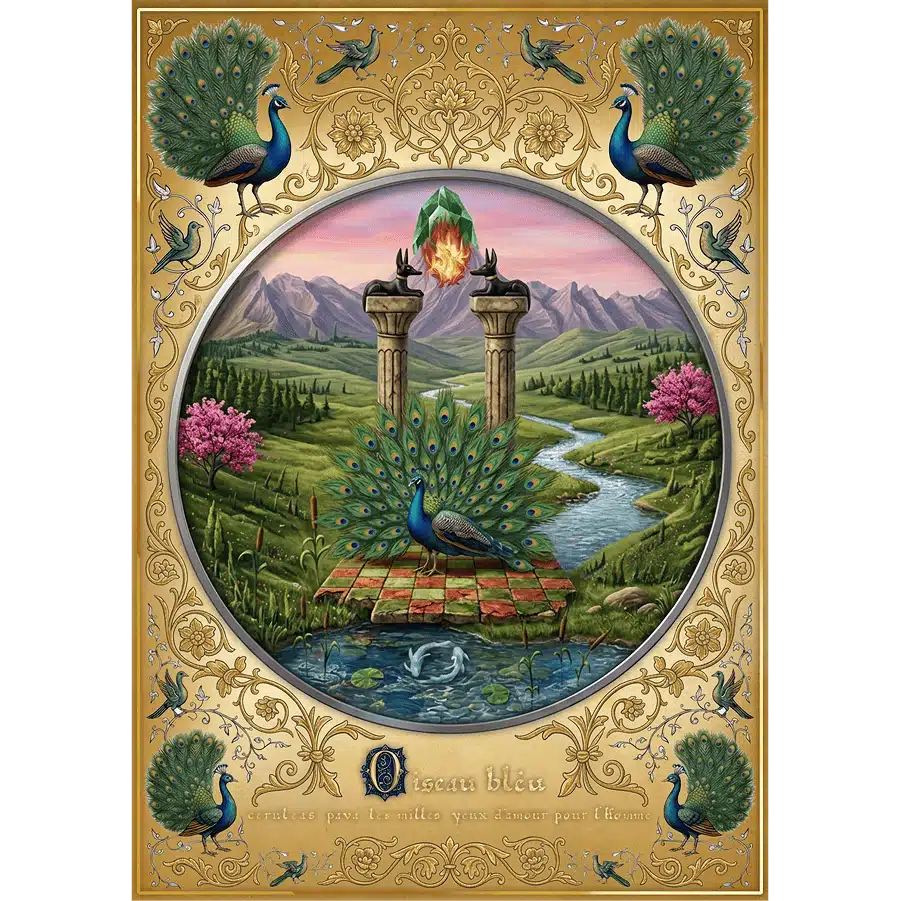
Blue is the light of the god made flesh
The color blue, rare in nature and difficult to produce, was perceived as a celestial substance. In Egypt, in India, in Mesopotamia, the blue skin of the gods does not represent a physical color but a cosmic matter. The skin of the god is the visibility of the divine — the surface where celestial light condenses, its way of appearing in the world.
The divine presence made tangible
Blue is the skin of the god. Nard is his breath. Together, they make the divine real. Blue embodies; perfume animates. Blue is presence; perfume is essence. Blue is the body of the god; perfume is his breathing soul.
When these two forces meet, light becomes flesh. With the divine breath filling space, the sensible world opens like a sanctuary. The divine no longer merely reveals itself — it unfolds in every direction of space, it envelops, it becomes a sacred atmosphere in which the soul recognizes its own origin.