
Sacred History of Kannauj: The Hunchbacked Virgin
The celestial garden as seen through ancient history and the sacred tradition of perfumes
For as long as one can trace back through archives and traditions, there has always been a desire to create a mystical presence in the land of Kannauj.
In the long history of humankind, Kannauj was one of the last strongholds of ancient hermetic science, home to one of the final colleges of knowledge known as amath.
Kannauj, the Hunchbacked Virgin
The etymology of Kannauj, from its earliest recorded names, consistently refers to knowledge, symbolized by the Virgin, and to the cycle of vitality, symbolized by the Bull.
The Hunchbacked Virgin teaches the sacred feminine of creation and knowledge through the understanding of the stars Sirius and Vega, which govern the cycles of nature.
A perfumed tradition was taught in the temples of Kannauj to honor the sacredness of life on all planes of existence.
The syncretism of symbols, the hump of the bull and the virgin, represents the image of the sacred mountain of knowledge: Mount Meru.

Mount Meru in Indian Tradition
It represents the Roof of the World, where the primordial God once dwelled on earth.
Mount Meru rests upon a great serpent guarding the treasures beneath the earth, the Naga, keeper of the tree of good and evil. The serpent symbolizes rebirth, taking the form of the new moon.
Mount Meru was once an island before becoming a mountain; this island was called Meroë, located within the kingdom of Kush in the northern regions of ancient India.
From this sacred mountain, four rivers—including the Ganges—emerge from the Himalayan plateau.
Mount Meru is also identified with the North Pole and Hyperborea.
From this northern point unfolds the three other directions, forming a triad:
Pushkar, in reference to the island; Benares; Kannauj.
Benares, where the Ganges flows northward, embodies divine sacredness.
In ancient times, the Ganges bathed and encircled Kannauj like a serpent coiled upon itself, knowledge germinating in the heart and intellect of humankind.
Ancient knowledge, Mount Meru, is the Hunchbacked Virgin with its sacred geography and botanical wisdom.
Kannauj and the Paradise of Northern India
Northern India was associated with paradise, with the knowledge of nature, perfumes, and cosmogony.
The root of the word paradise in Sanskrit is pardesha—para meaning “beyond” and desha meaning “place.”
This root is preserved in modern Hindi in the word Pradesh.
Originally, the kingdom of Kush extended from Afghanistan to Benares, encompassing the various regions known as Pradesh.
In ancient texts, paradise is described as a royal enclosure surrounded by walls, which gave rise to the Hebrew Pardes and the Greek Paradeisos.
The arrangement of the stars in the sky, studied through meticulous observation of the zodiac and cosmic cycles, favored Kannauj as a Garden and as a holy, sacred city.
It was once the ancient capital of India.
The layout of the city and its temples in semicircles reveals a deliberate intention to mirror the heavens in a marked place, continuing the age‑old tradition of the kingdom of Kush and the reference to the star Sirius and its celestial course.
This brings us back to the Tocharians (the ancient Kushite kingdom, the valley of flowers and perfumes).

The Tradition of Divine Science and Plants
Flowers and perfumes existed long before the arrival of the Mughals.
Kannauj was a sacred enclosure, a place where humans communed with the divine.
Kannauj, Capital of India, Capital of Perfume, and Last Bastion of Brahmanic Knowledge
The ancient temples once stood along the Ganges before its course shifted. They were bordered by gardens, and thanks to the alluvial silt, the soil was exceptionally fertile.
The proximity of water created a microclimate allowing several harvests per year.
The attars produced expressed the vitality of life and the quintessence of ancient knowledge.
The Renowned Kapoor Family of Kannauj
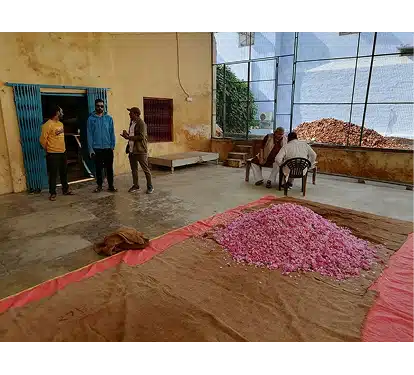
The Kapoor family owns a garden where flowers are still harvested for distillation. Remarkably, their vast garden stands on the site of the ancient temples, where the old meanders of the Ganges are still visible.
A fragrance of eternity emanates from the place.
This illustrious family continues to work in the world of perfume and possesses ancestral expertise reaching the pinnacle of mastery. Their knowledge has no equivalent.
Buddhist Influence
Kannauj came under Buddhist influence with the advent of Siddhartha, who was very present in these regions.
Builders of the Buddhist era re‑inscribed this tradition into architecture, where the history of the heavens and humankind was carved into stone.
The city embodied the image of the garden, filled with the presence of perfumes.
Kannauj Elsewhere in the World?
Several great sacred cities of antiquity were founded on the same principles, making the cities and the lands that hosted them “Mothers of the World.”
This logic is found in Egypt as well as in Persia.
It is noteworthy that there was a strong and intimate link between Egypt and Kannauj (as recorded by Claudius Ptolemy).
Ancient epoptes completed their studies either in India if they were Egyptian, or in Egypt if they were Indian.
Both countries were renowned for their perfume culture.

Toward the sensory world …